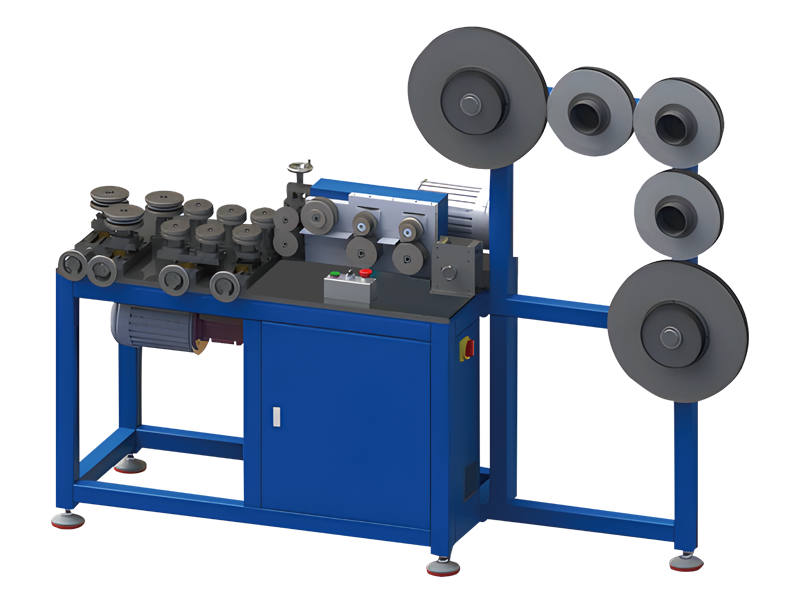
SZMATE Double jacketed gasket machines offer precision crafting for high-performance gaskets. Built for durability and efficiency, they ensure consistent quality, meeting rigorous industrial standards with reliable output.
The double jacketed gasket machine features progressive roller systems—pre-forming, edge-closing, and bending—with movable components that adapt to different gasket widths while maintaining structural integrity and material density.
The double jacketed gasket machine efficiently processes stainless steel strips and graphite/PTFE fillers, supporting various material thicknesses (3-4mm) to produce precise double-jacket gaskets in straight or circular forms based on application needs.
Semi-automated operation in this gasket equipment reduces manual labor, while ergonomic designs (like guided strip feeders and protective gloves) prioritize operator safety during high-speed production.
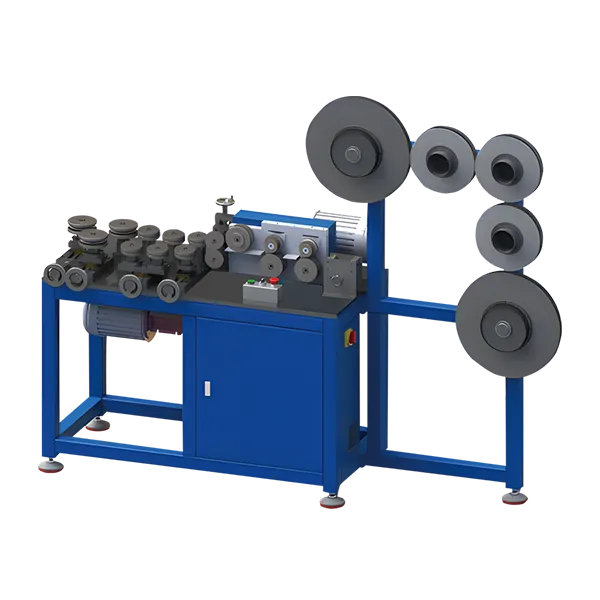
The Double Jacketed Gasket Machine transforms stainless steel strips and graphite packing tape/PTFE filler materials into high-performance sealing gaskets through an integrated forming and winding process. It begins by feeding precision-cut steel strips through progressive roller systems—first pre-shaping the lower strip into a U-channel, then precisely inserting layered filler material before encapsulating it with the upper strip. Multi-stage rollers with adjustable tension control gradually form and compress the composite structure, first pre-closing then fully sealing the edges to create a uniform 3-4mm thick profile; our gasket machine for sale features this advanced roller system as a core component. For ring gaskets, a bending roller system with variable positioning allows radius adjustment to accommodate diameters from 150mm to 3500mm. Critical components like the servo-controlled feed mechanisms ensure consistent material alignment, while interchangeable forming rollers enable quick adaptation between different gasket widths. The semi-automated process balances speed with precision, allowing operators to switch between straight bar production for welded assemblies or pre-curved rings—all while maintaining tight tolerances through sequential forming stations that progressively shape the metal jacket without compromising the delicate filler core. Our double jacketed gasket machine incorporates these advanced forming stations to deliver consistent quality across production runs. This streamlined workflow delivers finished gaskets with superior compression resistance and sealing integrity for industrial applications.
SZMATE double jacketed gasket machines are designed to form metal jacket materials with soft sealing fillers. The MDJ-23 supports stainless steel and alloy materials, while the jacket construction can be combined with graphite or PTFE filler according to the gasket requirement. Buyers using stainless steel strip should confirm strip width, thickness and finished gasket diameter before machine selection.
The MDJ-23 double jacketed gasket machine has a published maximum processing thickness of 4 mm. Because forming performance also depends on strip width, material grade and required bending diameter, SZMATE recommends confirming the actual gasket drawing rather than selecting the machine by thickness alone.
Yes. SZMATE double jacketed equipment can process graphite or PTFE filler between the formed metal jacket layers. When graphite is required, the specification of the graphite packing tape should match the jacket width, required gasket thickness and production process to maintain consistent filling and compression.
The achievable diameter depends on strip width and the selected machine configuration. For the MDJ-23, SZMATE publishes minimum bending diameters ranging from approximately 150 mm for a 10 mm strip width to 900 mm for a 25 mm strip width, so buyers should provide both gasket diameter and jacket width when requesting a quotation.
Selection should consider the metal jacket material, filler type, temperature, pressure and finished gasket construction. Buyers comparing different materials for gaskets should provide the actual operating condition and gasket drawing so the metal thickness and graphite or PTFE filler can be matched to the required sealing application.
The MDJ-23 operates in semi-automatic mode. It combines steel-strip forming, filler insertion, edge wrapping and ring bending while retaining operator involvement for material preparation and production control. This configuration is suitable for manufacturers that need flexible gasket equipment for customized metal-jacketed gasket sizes.