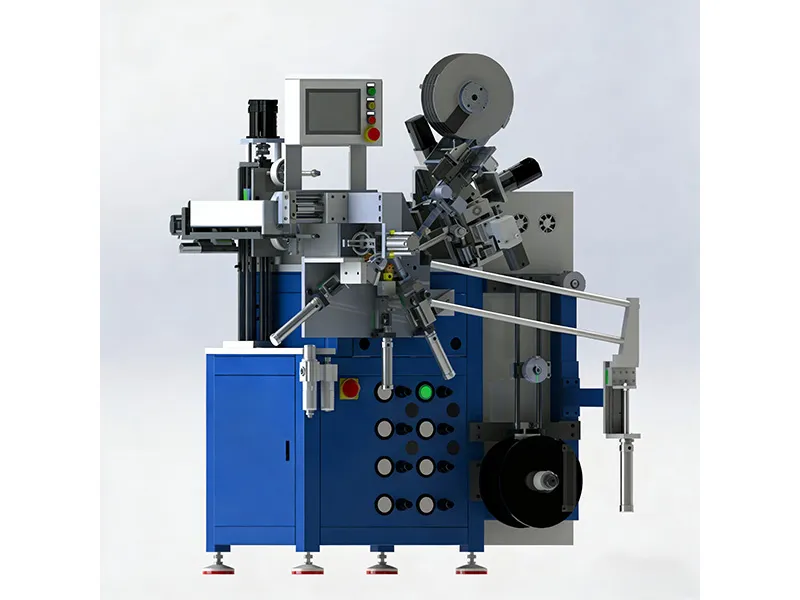
A double-jacketed gasket looks straightforward after it is finished: a soft filler is enclosed by metal and formed into the geometry required for a flange or heat-exchanger joint. Manufacturing it consistently is less straightforward. The metal must be shaped without tearing, the filler must remain centered, both jacket edges must close uniformly, and a circular product must reach the required diameter without creating local wrinkles or an unstable joint. The correct machine therefore has to be selected around the actual gasket construction rather than around a broad claim that it can “make double-jacket gaskets.”
This guide is written for industrial gasket manufacturers evaluating new capacity, replacing older forming equipment, or planning a more repeatable production route. It explains how the forming sequence works, which product dimensions matter, how MDJ-23 and MDJ-23S differ, and which data should be included in an RFQ. The focus is practical: the machine should fit the buyer’s normal product mix, reduce material loss, shorten setup without sacrificing control, and provide enough flexibility for custom industrial sealing orders.
For SZMATE, this topic is especially relevant because double-jacketed gasket production sits between material preparation and final gasket inspection. A machine can improve forming consistency, but reliable output still depends on qualified strip, filler dimensions, operator setup, ring geometry and a defined inspection method. The best equipment decision therefore starts with the gasket drawing and production history, not the machine brochure.
A double jacketed gasket machine is forming equipment that shapes metal strip around a soft filler to create a metal-jacketed sealing profile and, depending on the configuration, bends that profile into a finished ring.
In a typical production route, a lower metal strip is progressively formed into a channel. The filler is placed into that channel, then an upper strip or closing section is shaped over the filler. Additional rollers gradually close the jacket edges rather than forcing the final geometry in one severe forming step. For circular gaskets, the finished composite profile is then bent to the required diameter.
The sequence matters because stainless steel and alloy strip have springback, while graphite or PTFE filler can shift or compress if it is not supported evenly. A machine with adjustable forming rollers allows the operator to tune the profile in stages. This helps avoid sharp local deformation and makes it easier to preserve the filler distribution across the gasket width.
The machine is not the same as a generic ring bender. A ring bender controls curvature, but the jacketed-gasket process must first create a stable metal-and-filler composite section. Buyers should therefore confirm whether the quoted system performs channel forming, filler accommodation, edge closing and bending, or only one of these operations.
A double jacketed gasket machine forms the gasket progressively so that metal geometry and filler placement remain controlled from the first U-shaped section to the final closed jacket.
The first forming stage creates the basic channel. Rather than folding the metal immediately to its final angle, rollers introduce the profile gradually. This reduces concentrated stress at the strip edge. After the filler has been positioned, subsequent rollers pre-close and then fully close the jacket. The final profile should hold the filler firmly without crushing it unevenly.
For an operator, the important setup variables are strip width, strip thickness, filler width, filler build-up, roller position and feed alignment. A change in one variable can affect several others. A wider filler package, for example, may require a different pre-closing position before the last edge-forming stage. Production instructions should therefore be organized by approved gasket construction rather than only by nominal diameter.
SZMATE’s MDJ-23 is designed to combine straight profile production and ring bending in one process. Its published specification lists a maximum thickness of 4 mm and an adjustable line speed of 0–200 mm/s. Those figures are useful starting points, but a buyer should verify what the stated maximum thickness represents in the intended gasket construction and test representative materials before treating it as a production limit.
A stable process should also be observable. Operators need clear access to see whether the filler is centered, whether edges are closing symmetrically and whether the strip is tracking correctly. When a machine is selected only for speed, these setup and verification requirements are often underestimated.
The required diameter range should be defined by real order history because minimum bend diameter changes with profile width, strip condition and gasket construction.
The MDJ-23 specification illustrates this relationship clearly. For a 25 mm-wide profile, the published minimum bend size is 900 mm. At 20 mm width it is 800 mm; at 16 mm it is 600 mm; at 13 mm it is 200 mm; and at 10 mm it is 150 mm. The same machine therefore does not have one universal minimum diameter independent of width.
| Profile Width | Published MDJ-23 Minimum Bend Size | Production Implication |
|---|---|---|
| 25 mm | 900 mm | Wide profiles require a larger practical bending radius. |
| 20 mm | 800 mm | Still oriented toward larger circular gaskets. |
| 16 mm | 600 mm | Provides greater diameter flexibility. |
| 13 mm | 200 mm | Suitable for substantially smaller rings. |
| 10 mm | 150 mm | Smallest published MDJ-23 bending value. |
This is why buyers should prepare a size-by-width matrix. List the smallest and largest diameter for every common jacket width, then add annual quantity. A single headline range such as “150–3500 mm” does not show whether the machine can form the buyer’s smallest wide gasket or whether that part needs a different manufacturing route.
At this stage of the article, manufacturers comparing equipment can review SZMATE’s double jacketed gasket machine category to see how the standard and small-size machines are separated. This internal division reflects a real process issue: small soft rings may need a different blank and forming strategy rather than simply reducing the bend diameter on the larger machine.
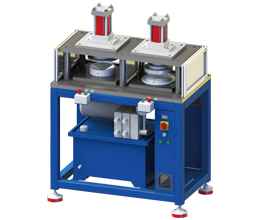
The MDJ-23 and MDJ-23S address different forming routes, so the correct choice depends on whether the factory primarily bends a formed profile or closes jackets around pre-cut smaller rings.
MDJ-23 is the broader forming-and-bending machine. It is semi-automatic, uses two 1.1 kW drive motors, has a published 0–200 mm/s line-speed range and supports stainless steel and alloy materials. Its maximum published thickness is 4 mm. The machine is designed to create the jacketed bar and bend it into a ring during the production sequence.
MDJ-23S follows a different logic. SZMATE describes smaller gasket sizes as difficult to bend from a soft composite profile. In that route, the ring can first be cut from sheet by laser or plasma, then formed into a U-shaped section, filled with graphite strip and closed at both edges. The MDJ-23S is also semi-automatic, uses a 0.75 kW motor, has a published 0–200 mm/s line speed and lists a 10-inch to 3500 mm ring-size range with 0.8 mm maximum thickness in its current specification.
| Selection Factor | MDJ-23 | MDJ-23S |
|---|---|---|
| Primary production route | Form jacketed profile, then bend to ring | Form and close jacket around pre-cut smaller ring |
| Work mode | Semi-automatic | Semi-automatic |
| Published maximum thickness | 4 mm | 0.8 mm |
| Published line speed | 0–200 mm/s | 0–200 mm/s |
| Drive power | 2 × 1.1 kW | 0.75 kW |
| Machine profile | 2200 × 750 × 1720 mm | 1550 × 500 × 1200 mm |
| Best evaluation method | Test width, filler build and bending diameter together | Test pre-cut ring geometry and two-step edge closing |
The comparison should not be reduced to “large machine versus small machine.” The processing route is different. If the customer’s drawings include many small ring gaskets that cannot be bent cleanly after profile forming, a pre-cut ring route may be more stable. If most production consists of larger custom diameters and multiple jacket widths, MDJ-23 may offer the more direct process.
For factories with both product families, the most efficient answer may be two complementary machines rather than forcing one setup to cover every geometry. The purchasing decision should be based on annual volume and changeover frequency, not only on whether a one-off sample can technically be produced.
Material selection affects forming force, springback, edge closure and filler stability, so machine trials should use the same strip and filler grades planned for production.
Stainless steel is widely used for jacketed gaskets because it combines corrosion resistance with predictable forming behavior, but different grades and tempers do not respond identically. Alloy material can require different roller settings. Even within the same nominal grade, edge condition and strip thickness tolerance influence the final profile.
The filler has a different role. Graphite provides conformability and temperature capability, but it can be damaged if the metal jacket closes too aggressively or if the filler width is poorly controlled. PTFE behaves differently under compression and may require another approved setup. A machine qualification should therefore include more than one diameter; it should include representative metal/filler combinations.
SZMATE’s current graphite material page publishes a batch inspection example with 99.12% carbon content, 1.0 ± 0.05 g/cm³ density, 35 ppm chlorine and 44.27% compressibility. These are batch-specific reported values rather than universal specifications, but they show the type of data a gasket manufacturer should retain when linking raw material quality to forming results.
When graphite is part of the approved construction, procurement teams can use the graphite gasket tape information as a reference for the kinds of material properties that should be checked before a forming trial. The machine setup and the incoming-material specification should be developed together instead of being managed by separate departments.
Quality control should verify the composite profile before ring completion so filler shift, incomplete edge closure and forming defects are detected early.
A practical control plan starts with incoming strip and filler. Measure strip thickness and width, check edge damage, confirm the material identity and verify filler dimensions. During setup, inspect the U-shaped pre-form before filler loading. If the channel is asymmetrical at this stage, later rollers will not reliably correct it.
After the filler is inserted, inspect centering before complete closure. The operator should look for local bulging, voids or areas where the jacket is compressing the filler more strongly than elsewhere. After the final closing rollers, check profile thickness and both edges at several points.
For circular products, diameter and roundness should be measured after bending. Large rings may need multiple readings around the circumference rather than one nominal diameter. The joint location also needs an approved finishing and joining method. If a welding step follows, distortion from that operation should be included in the final inspection plan.
Documentation is particularly useful for custom orders. Record machine model, roller set, material lot, filler type, profile width, target diameter and critical settings. When the same gasket returns six months later, the factory can reproduce the proven setup instead of depending on operator memory.
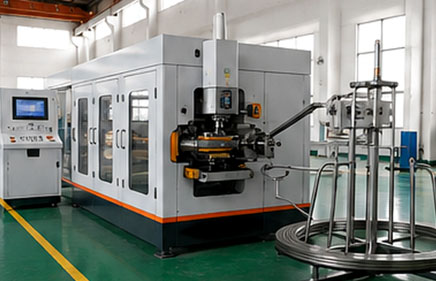
Line speed should be selected for stable forming and filler control, because the fastest feed setting does not necessarily produce the lowest cost per accepted gasket.
Both MDJ-23 and MDJ-23S currently list a 0–200 mm/s line-speed range. That range provides adjustability, not a promise that every gasket should be run at 200 mm/s. Wide profiles, delicate filler, difficult alloys or small bend radii may require a slower setting to maintain consistent closure.
Capacity is better estimated from finished linear length or completed rings per hour. A circular gasket with a 1000 mm diameter requires approximately 3.14 m of circumference before allowances for the joint and forming method. At a theoretical 200 mm/s feed rate, 3.14 m passes the rollers in about 15.7 seconds, but that figure excludes material loading, pre-forming preparation, filler placement, bending adjustment, cutting, joining, inspection and changeover.
A production study should therefore record three times separately: machine running time, operator touch time and total elapsed time per accepted gasket. This distinction reveals the real bottleneck. If the machine runs for 20 seconds but the operator spends two minutes preparing filler and the ring blank, increasing roller speed creates little business value.
For high-mix factories, changeover may be more important than peak speed. Grouping orders by jacket width and material can reduce roller adjustment and trial pieces. Standard setup sheets and prepared material kits can improve output without changing the machine.
The production cell should provide straight material flow, safe access to rollers and bending areas, and enough space to handle large rings without damaging them.
MDJ-23 has a published machine profile of 2200 × 750 × 1720 mm and a maximum occupied area of approximately 2300 × 800 mm for the equipment itself. The working cell must be larger. Strip storage, filler preparation, ring support, inspection tables and operator movement all need additional space.
Large-diameter rings can become awkward before they become heavy. Operators may need to support a wide circumference while the profile is being bent. Provide stands, low-friction supports or lifting assistance appropriate to the size range. Avoid placing material racks where an operator must step over strip or finished rings to reach the control panel.
Roller nip points are a major hazard in forming equipment. Guarding, emergency stops and safe setup procedures should prevent hands from entering an active forming zone. Maintenance work should include an energy-isolation procedure before rollers, drives or electrical systems are serviced.
Machine procurement should also include the operating manual, electrical drawing, recommended spare parts, forming-roll maintenance instructions and training. A stable process depends on keeping roller surfaces, alignment and bearings in condition; poor mechanical maintenance eventually appears as quality variation.
A useful RFQ describes the gasket portfolio and acceptance criteria so the supplier can confirm the correct machine, tooling and process route before quotation.
Start with drawings for several representative products rather than only the largest and smallest nominal diameter. Include jacket width, metal thickness, filler build, finished profile thickness, material grades and joining details. Then provide annual volume and typical batch size. A manufacturer producing ten large custom rings per month has different requirements from one producing hundreds of repeated sizes per shift.
Ask the supplier to identify the machine boundary: which steps are automatic, which are manual and which need separate equipment. Clarify whether cutting, welding or final surface finishing is included. Request utility data, tooling list, changeover method and the expected operator tasks.
Raw-material selection should also be part of the RFQ. The gasket making material page is a useful internal reference point because it connects equipment decisions with stainless steel strip and graphite filler options. In a real project, the customer should send the actual qualified material or an equivalent trial lot for factory acceptance testing.
The final acceptance test should produce multiple representative gaskets, not one demonstration piece. Measure profile thickness, edge closure, diameter, roundness and visible filler condition. Include at least one changeover so both parties can verify the practical setup method before shipment.
These FAQs address the main technical questions buyers should resolve before selecting a double jacketed gasket machine.
MDJ-23 is designed to form a jacketed profile and bend it into a ring, while MDJ-23S is intended for a route in which smaller rings can be pre-cut and then formed, filled and edge-closed. Their published thickness limits, power and machine dimensions also differ, so selection should follow the actual gasket drawing.
No machine should be selected on diameter alone. Minimum bend size changes with jacket width and material behavior. MDJ-23, for example, publishes different minimum bend values from 150 mm to 900 mm depending on profile width. Buyers should evaluate diameter and width together.
No. It is the top of the published adjustable range. Actual production speed should be set according to material, filler stability, profile width and bend conditions. Finished good gaskets per hour is a more useful performance metric than maximum feed speed.
The SZMATE category description identifies graphite and PTFE as common filler options for double-jacket production. The machine setup may differ because the materials compress and handle differently. A factory acceptance test should use the buyer’s intended filler.
Verify incoming material, U-channel symmetry, filler centering, complete edge closure, finished profile thickness, diameter, roundness and joint condition. For recurring products, record machine settings and material lots so approved setups can be reproduced.
Send gasket drawings, diameter range, jacket width, metal and filler materials, thicknesses, annual volume, typical batch sizes and the required forming route. Also include local voltage, factory space and any specific inspection or acceptance requirements.
The best double jacketed gasket machine is the one that can reproduce the buyer’s actual jacket widths, materials and diameters with controlled filler placement and repeatable edge closure.
MDJ-23 is suited to a broad forming-and-bending route and publishes a maximum thickness of 4 mm with variable minimum bend sizes according to jacket width. MDJ-23S addresses smaller-ring production through a different forming strategy. Neither model should be chosen from the model name alone.
Before investing, build a product matrix, identify the high-volume constructions and run representative materials. Verify the complete process from channel forming to final ring inspection, including changeover and operator work. SZMATE can then match the machine and tooling to the real production requirement rather than forcing the customer’s gaskets into a generic setup.