High-speed manufacturing lines in 2026 have a marking problem that traditional solutions cannot solve. When a gasket production line runs at 200 parts per minute, when an automotive component conveyor moves at 8 meters per second, when a packaging line generates 500 coded units per hour—stopping each product at a fixed station for static marking is not a bottleneck. It is a production design failure. The marking system becomes the constraint that limits the entire line's output, and every second of stop-and-mark time is a second of lost throughput that cannot be recovered.
A modern laser marking machine with online synchronization capability eliminates this constraint entirely. By integrating the laser with conveyor speed signals, position sensors, and industrial control software, the system marks each product while it continues moving—with no deceleration, no stopping, and no manual handling. SZMate's laser marking machine collection is designed for accurate, high-speed engraving for gaskets and industrial applications, supporting permanent, high-contrast marking on metals, plastics, ceramics, and composites with adjustable power and frequency settings. For production teams evaluating online laser marking machine systems, marking on the fly technology, and automated laser integration for high-volume manufacturing, the sections below cover the working principle, specification requirements, application fit, and TCO logic.
The limitations of traditional marking methods become critical constraints as production speeds increase. Ink labels peel, fade, and become unreadable in industrial environments. Inkjet systems require consumables, maintenance, and drying time. Manual marking creates human error, inconsistent positioning, and labor cost that scales with volume. Mechanical stamping requires stopping and clamping. None of these methods can keep pace with a modern high-speed production line without creating a bottleneck.
A laser marking machine addresses each of these limitations simultaneously. The laser beam creates permanent marks by locally modifying the material surface—through ablation, annealing, foaming, or engraving depending on the material and laser parameters—without physical contact, without consumables, and without the drying or curing time that ink-based methods require. The marks are resistant to abrasion, chemicals, heat, and UV exposure, making them suitable for industrial traceability applications where label-based marking would fail.
The 2026 production environment adds additional requirements beyond basic marking capability:
Traceability integration is now a standard requirement in automotive, aerospace, medical device, and food processing supply chains. Every marked component must carry a unique identifier that connects it to production batch data, inspection records, and supplier information in the factory MES system. A marking system that cannot communicate with the MES in real time creates a data gap that undermines the entire traceability program.
Unmanned production is increasingly the target operating model for high-volume manufacturing. A marking system that requires operator intervention for each product, each batch change, or each shift startup is incompatible with the unmanned production model that 2026 factories are building toward.
Variable data marking—where each product receives a unique serial number, QR code, or barcode generated from a database or MES work order—requires software capability that static marking systems cannot provide.
SZMate's laser marking machines support fully automatic loading systems, real-time data communication, barcode and serial number marking, and unmanned production capability—a feature set that directly addresses the 2026 production requirements described above.
Marking on the fly technology is the technical capability that allows a laser marking system to mark products accurately while they are moving on a conveyor, without stopping or slowing the production line.
The synchronization mechanism
A conveyor encoder—a rotary sensor attached to the conveyor drive—generates a pulse signal proportional to conveyor speed. This signal is fed continuously to the laser marking controller. When a photoelectric sensor or vision system detects an incoming product, the controller uses the encoder signal to calculate the product's position in real time, updating the calculation at the encoder's pulse frequency (typically thousands of times per second).
The marking controller uses this position data to offset the laser beam's target coordinates dynamically—moving the beam in the direction of conveyor travel at the same speed as the product, so that from the laser's perspective, the product appears stationary. The galvanometer mirror system executes the marking pattern within this moving reference frame, producing marks that are correctly positioned on the product despite its continuous movement.
The galvanometer mirror system
High-speed galvanometer scanners are the mechanical component that makes marking on the fly possible. Two mirrors—one controlling the X-axis beam position and one controlling the Y-axis—are driven by high-torque servo motors that can reposition the beam at speeds of 5–10 m/s with positioning accuracy of ±0.05mm. This combination of speed and accuracy allows the system to complete a complex marking pattern—a QR code, a serial number, a logo—within the time window available as the product passes through the marking field.
The industrial communication interface
For MES integration, the marking controller communicates with the factory control system through industrial protocols including Modbus, Profinet, Ethernet/IP, RS485, or TCP/IP depending on the factory's automation architecture. Before each product is marked, the MES sends the variable data—serial number, batch code, date, inspection result—to the marking controller. After marking, the controller confirms completion and can send the marked data back to the MES for traceability record creation. This bidirectional communication loop is the foundation of automated laser integration in a smart factory environment.
SZMate's systems achieve marking accuracy of ±0.05mm and operating speeds of 5–10 m/s, with real-time data communication capability for MES and PLC integration.
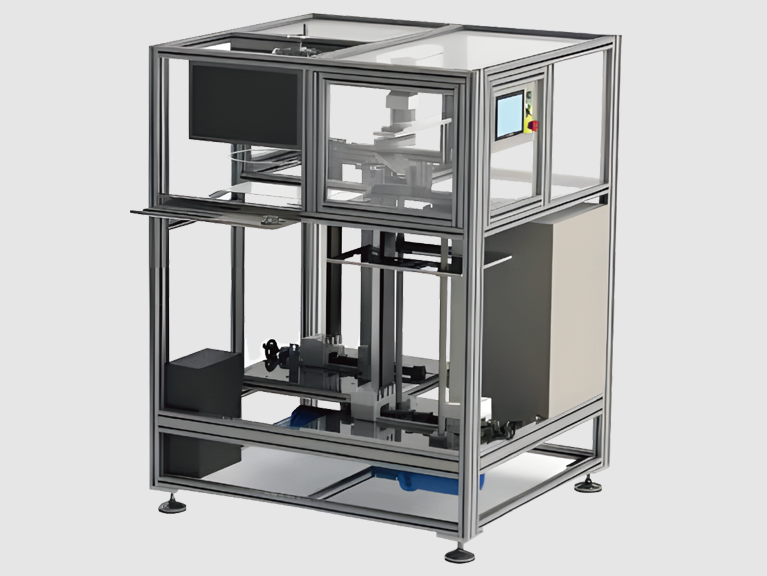
Selecting an online laser marking machine for high-speed production requires evaluating synchronization capability, marking speed, software flexibility, and communication interfaces—not only laser power and marking area.
Laser Source Selection
| Laser Type | Best Materials | Key Advantage |
|---|---|---|
| Fiber laser | Metals, some plastics | High contrast on metal, long service life |
| CO₂ laser | Non-metals, plastics, wood, glass | Broad non-metal material coverage |
| UV laser | Sensitive plastics, glass, PCB | Low heat input, fine detail |
| YAG laser | Metals, ceramics | Deep engraving capability |
Complete Specification Checklist
Marking speed and conveyor synchronization: confirm that the system's galvanometer speed and encoder synchronization capability match the conveyor speed of the production line. A system rated for 5 m/s conveyor speed cannot reliably mark products on a 7 m/s line.
Marking accuracy: confirm positioning accuracy (±0.05mm class for precision applications) and repeatability across the full marking field. Accuracy degrades toward the edges of the marking field in galvanometer systems—confirm accuracy at the actual marking position, not only at the field center.
Marking field size: confirm that the marking field covers the required marking area on the product. Larger fields require longer focal length optics, which reduces marking resolution and power density.
Trigger system: confirm the trigger method—photoelectric sensor, vision system, or PLC signal—and the trigger-to-mark latency. High latency creates positional error at high conveyor speeds.
Software capability: confirm support for serial number generation, barcode and QR code marking, variable data from database or MES, batch code management, and font/logo import.
Industrial communication: confirm the communication protocol required for MES integration and verify compatibility with the factory's existing automation architecture.
Material compatibility: confirm that the laser source and power settings produce the required mark quality on the specific production material—metal grade, plastic type, coating, or composite.
Fume extraction and safety: confirm that the system includes appropriate fume extraction for the marking material and laser safety enclosure for the operating environment.
Gasket Manufacturing
Laser marking on gaskets adds size designation, material grade, batch number, manufacturer logo, and traceability codes without consumable labels that can contaminate sealing surfaces or detach in service. SZMate's laser marking machine page is specifically positioned for gasket manufacturers, where permanent, chemical-resistant marking is a quality requirement rather than an option. Online marking integrated with the gasket cutting or punching line eliminates the separate marking station that creates a bottleneck in traditional gasket production workflows.
Metal Parts and Industrial Components
Permanent laser marking on metal parts supports part identification, anti-counterfeiting, and quality tracking across the supply chain. For automotive and machinery components, the marked code connects each part to its production batch, material certificate, inspection data, and supplier information—creating the traceability record that OEM customers increasingly require as a supply chain qualification condition.
Packaging and Production-Line Coding
Online marking on packaging lines can print batch codes, date codes, QR codes, and serial numbers while packages move on the conveyor at full line speed. Compared with inkjet coding, laser marking eliminates ink consumable cost, reduces maintenance frequency, and produces marks that are more resistant to moisture, abrasion, and chemical exposure in distribution and retail environments.
Automotive and Machinery Parts Traceability
Automotive supply chain traceability requirements have expanded significantly in recent years, with OEMs requiring unique part identification that can be scanned and verified at every stage of the assembly process. Online laser marking with MES integration allows each part to receive its unique identifier at the point of production, with the marked data automatically recorded in the traceability system without manual data entry.
Smart Factory and MES Integration
Variable data marking—where each product receives a unique code generated from a MES work order—is the foundation of smart factory traceability. The marking system becomes a node in the factory's data network, receiving marking instructions from the MES and confirming completion in real time. This integration eliminates the manual data entry, transcription errors, and traceability gaps that occur when marking is managed separately from the production control system.
Installation and Integration Workflow
Step 1: Define the product and marking requirements. Material, shape, surface finish, marking area dimensions, marking content (logo, serial number, QR code, barcode, batch code, variable data), required contrast and depth, and code readability standard.
Step 2: Confirm conveyor parameters. Conveyor speed range, speed stability, product spacing, product orientation consistency, and available trigger signal (encoder, photoelectric sensor, or PLC).
Step 3: Select the laser source. Fiber for most metals; CO₂ for non-metals and plastics; UV for sensitive materials or fine detail requirements. Confirm power level against the required marking depth and speed on the specific material.
Step 4: Plan the marking field and optics. Confirm that the marking field covers the required area with adequate accuracy at the edges. Plan the mounting height and angle to achieve the required focal distance.
Step 5: Configure software and communication. Set up serial number generation, variable data connection to MES or database, barcode and QR code parameters, and industrial communication protocol. Test the full data flow from MES work order to marked product to traceability record before production commissioning.
Step 6: Install fume extraction and safety systems. Confirm fume extraction capacity for the marking material and laser power level. Install safety interlocks, warning lights, and enclosure as required by the operating environment and local safety regulations.
Step 7: Validate marking quality and position accuracy. Run production trials at the actual conveyor speed, confirm code readability with a barcode scanner or vision system, verify position accuracy across the marking field, and document the results as the acceptance standard.
Maintenance and TCO Advantages
No consumables is the most immediate TCO advantage. A laser marking system has no ink, no labels, no solvents, and no print heads to replace. The operating cost is essentially electricity and periodic lens cleaning—a fraction of the consumable cost of inkjet or label-based marking systems at equivalent production volumes.
Higher throughput from online marking versus stop-and-mark processes directly improves production capacity without capital investment in additional equipment. For a line that previously stopped for 2 seconds per part for marking, eliminating that stop on a 200-part-per-minute line recovers 400 seconds of production time per minute—effectively increasing line capacity by the marking cycle time fraction.
Lower labor cost from automated loading, marking, and data communication reduces the operator headcount required for the marking operation. SZMate's systems support fully automatic loading and real-time data communication, enabling unmanned operation during normal production.
Better traceability from automated MES integration reduces the administrative cost of traceability management and the risk of traceability failures that create recall exposure in regulated industries.
Longer service life from solid-state laser sources (fiber lasers typically have 100,000+ hour rated service life) reduces the maintenance and replacement cost compared with lamp-pumped or consumable-based marking systems.
Production lines in 2026 cannot afford slow, manual, or stop-and-go marking. A modern laser marking machine with online conveyor synchronization, variable data control, and automated MES integration helps manufacturers increase throughput, eliminate consumable cost, improve traceability, and connect marking data with factory control systems in real time. SZMate provides laser marking machine solutions for gasket and industrial manufacturing applications, supporting accurate, high-speed, durable, and clear marking with ±0.05mm accuracy and 5–10 m/s operating speed capability for demanding production environments.
Visit the SZMate Laser Marking Machine product page to request a recommended configuration and quotation.
Please submit the following details for an accurate recommendation:
Work condition: Industry, product material, conveyor speed, marking environment, dust or fume condition, automation level required
Quantity: Single machine, production-line upgrade, multi-line project, or annual procurement plan
Size/spec: Marking area, marking content, product dimensions, laser type preference, conveyor width, sensor or encoder requirements, communication protocol
Target metrics: Marking speed, accuracy class, code readability standard, MES integration requirement, unmanned operation target, downtime reduction goal
Current problems: Stop-and-mark bottleneck, unreadable codes, manual coding errors, high consumable cost, poor MES traceability, unstable marking position at high speed
1. What is a laser marking machine?
A production system that uses a focused laser beam to create permanent marks—text, logos, barcodes, QR codes, serial numbers, or batch codes—on materials including metals, plastics, ceramics, composites, and industrial gasket products. Marks are created by locally modifying the material surface without physical contact or consumables, producing results that are resistant to abrasion, chemicals, heat, and UV exposure.
2. Laser marking vs. inkjet marking: which is better for industrial production?
Inkjet marking is cost-effective for low-speed packaging lines where mark permanence is not critical. Laser marking is the better choice for industrial traceability, metal parts, gaskets, and high-speed automated production because it produces permanent marks without ink consumables, requires less maintenance, integrates more reliably with MES systems, and produces marks that remain readable throughout the product's service life in industrial environments.
3. What is the ROI of online laser marking?
ROI comes from higher throughput (eliminating stop-and-mark cycle time), reduced consumable cost (no ink, labels, or solvents), lower labor cost (automated loading and data communication), fewer coding errors (automated variable data from MES), better traceability (real-time MES integration), and longer equipment service life (solid-state laser sources with 100,000+ hour rated life).
4. Does marking on the fly require production line modification?
Yes, some integration work is required: conveyor encoder installation for speed synchronization, trigger sensor placement for product detection, laser safety enclosure installation, fume extraction system, PLC or MES communication wiring, and marking-position calibration at the actual production conveyor speed. The scope of modification depends on the existing line layout and automation architecture.
5. What parameters are needed for correct selection and quotation?
Product material and surface condition, marking content (logo, serial number, QR code, barcode, batch code, variable data), marking area dimensions, conveyor speed range, required marking accuracy, production line layout, laser source preference, automation level (manual load, semi-automatic, fully automatic), communication protocol for MES integration, annual production volume, and current marking problems such as stop-and-mark bottleneck, unreadable codes, or traceability gaps.